Findings, not filler.
Findings we measured ourselves, and plain explainers of the concepts behind them — starting from general finance, then narrowed to how it works on P2P.
Maker vs. taker — the full comparison
referenceSame board, two completely different trades — a side-by-side table of what each role is actually doing, competing against, and optimizing for.
Rate limits shape what any P2P tool can tell you
Any page showing many P2P markets at once is making a choice between fresh and complete. It usually will not tell you which. Here is the constraint that forces the choice.
Thin rails lie: why ranking by widest spread finds nothing worth trading
We ranked one market's rails by spread and got Neteller at 11.08 against 8.72 — a 27% gap, on a couple of ads. The real market that day was 0.41%.
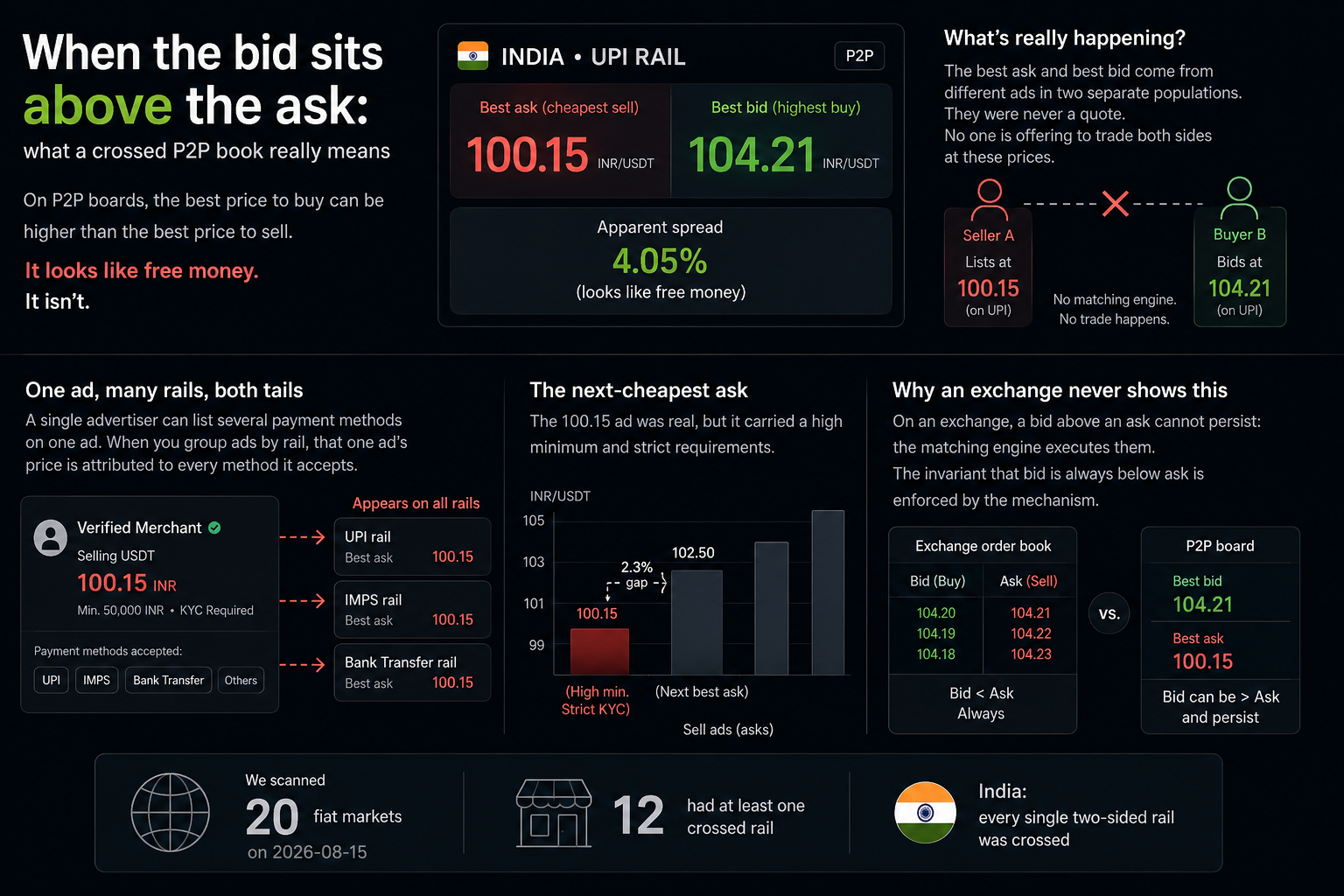
When the bid sits above the ask: what a crossed P2P book really means
A rail quoting 100.15 to buy and 104.21 to sell looks like a 4% arbitrage. It is not. It is an artifact of how P2P boards are read, and it appeared on 12 of the 20 markets we scanned.
Your advertised maximum is not what you can fill
An ad's advertised maximum isn't what it can actually fill right now. dynamicMaxSingleTransAmount is — and reading it wrong sets viable-looking trades that can't clear.
The 0.2% Binance P2P fee is not what you think it is
Most makers model the 0.2% fee as a cut of their spread. It isn't. It's charged on price, on both legs — which turns it into a fixed toll that doesn't scale the way people assume.
The monthly market report, explained
Every month, one automated report per market: spread trend, best-paying rail, notable merchant behavior. Here's exactly what's in it and where the numbers come from.
We rebuilt our spread calculation and found we were 40% too tight
Two bugs, both making viable trades look unprofitable. After the fix: 200 of 200 merchants profitable, market-wide gain of over 60,000 MAD that our own dashboard had been hiding from us.
Where the fat spreads hide: why the tail rails matter
A board-wide scan finds the top price. It systematically misses the rail with three ads and a wide-open spread, because that rail is buried on page four.
How to read a P2P merchant: behavior over the label
A merchant's self-description tells you nothing. How often they reprice, how deep they sit in the queue, and how many rails they cover tells you almost everything.
Is P2P trading actually easy? What's simple, and what isn't
Almost every 'is P2P trading easy' answer is describing the taker experience — a few clicks, done. Nobody's answering it for the maker side, where the actual difficulty lives.
Maker vs. taker: an old market-structure idea, and what it means on P2P
Stock ECNs, forex platforms, and centralized crypto exchanges have used maker/taker fee models for decades. P2P runs on the same underlying idea — it just looks different because there's no shared order book.
Scam-proofing a P2P trade: why merchant data beats manual vigilance
Checking for fake payment screenshots and canceled-order tricks is standard advice. It's also incomplete — those checks only work on the trade in front of you, not the pattern behind it.
Binance P2P vs. spot trading: which is actually more profitable?
Most answers to this compare fee percentages and stop there. The real answer is that P2P and spot profit from entirely different things, and the fee comparison alone tells you almost nothing.
Payment rails, explained: how P2P trades actually settle
A 'rail' isn't crypto jargon — it's the payment method a trade settles through, the same concept banks call ACH or wire. P2P just makes you pick one per trade, and that choice changes the price.
Should you become a P2P merchant? What the economics actually require
The application to become a P2P merchant takes minutes. The decision of whether it's worth your capital takes a real margin calculation — this is that calculation.
What is a bid-ask spread? From stock exchanges to P2P crypto
The bid-ask spread isn't a crypto invention. It's the oldest idea in market-making — this is how it works everywhere, and what changes when the market is a stack of individual ads instead of one order book.
What actually triggers a P2P appeal — and what it does to a merchant's reliability score
One appeal is a disagreement between two traders. A pattern of appeals against the same merchant is data — and it's visible before you ever have to file one yourself.
Got a question, a request, or spotted something off? Contact us.